Portrait of Maxime Ronceray

Maxime RONCERAY

Astrophysics - Data Science

I build machine-learning tools to find unusual galaxies and infer their physical properties from large astronomical surveys.

  1. Nov 2026 – 2029PhD in astrophysics at CEA: Probabilistic machine learning for galaxy surveys and next-generation cosmology.
  2. Mar 2026 – Sep 2026Galaxy population inference at CEA: Learning galaxy-population priors and fast physical posteriors with differentiable models and variational inference.
  3. Sep 2025 – Apr 2026Foundation model for anomaly detection: Benchmarking AstroPT, AstroCLIP and AION to discover rare objects in matched Euclid images and DESI spectra.
  4. Sep 2024 – Sep 2026MSc Data Science & AI: MSc in Data Science and AI, focused on machine learning, statistics and scientific computing.

Loading the universe

Redshifting galaxies...

Publications

Papers

    Conferences

    Posters

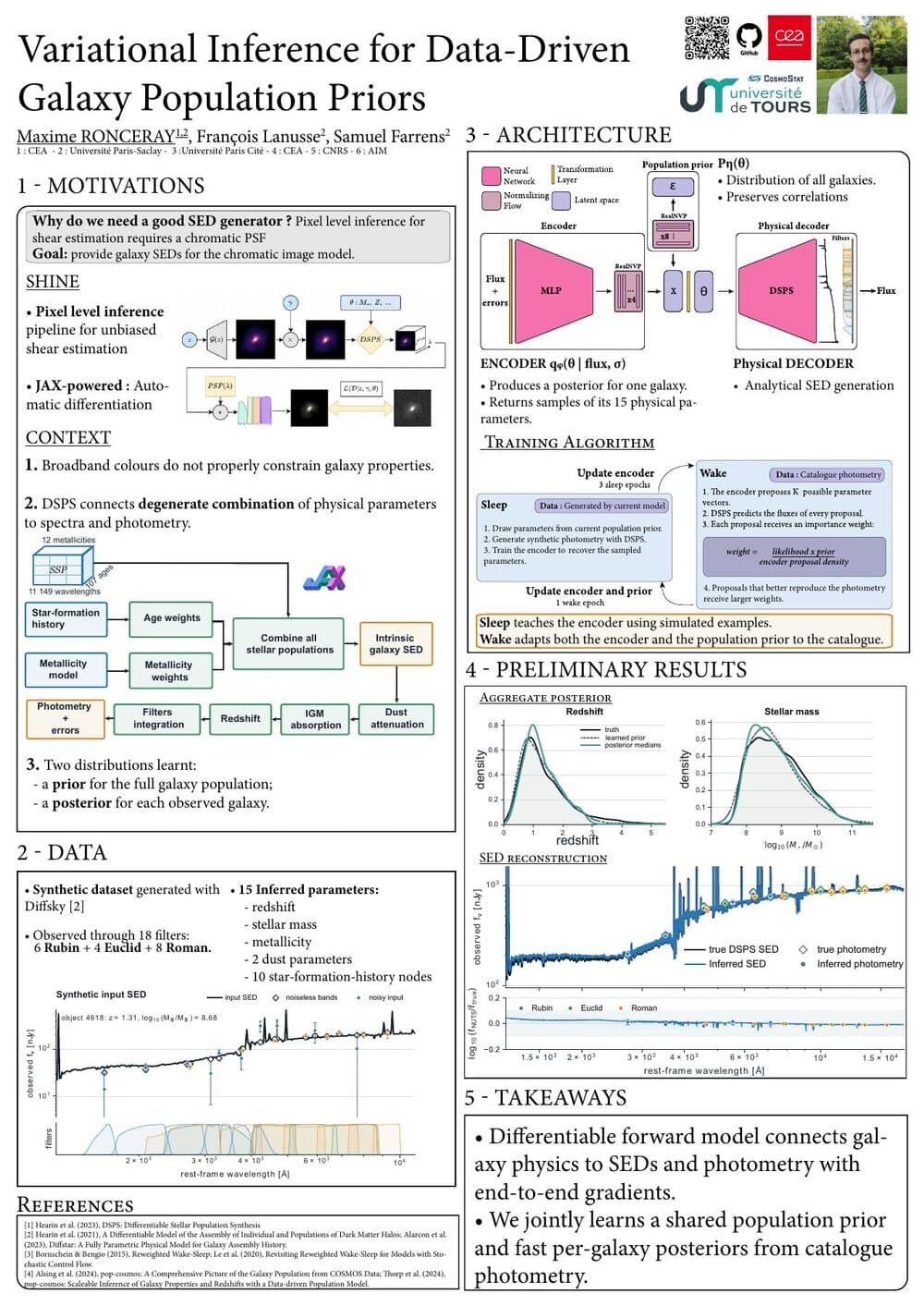
    • Poster presenting the architecture and preliminary results for data-driven galaxy population priors01

      Poster · 2026

      Variational Inference for Data-Driven Galaxy Population Priors

      CEA · Université Paris-Saclay

      A differentiable inference pipeline that jointly learns a galaxy-population prior and fast per-galaxy posteriors from catalogue photometry using DSPS and reweighted wake-sleep.

      Open full poster
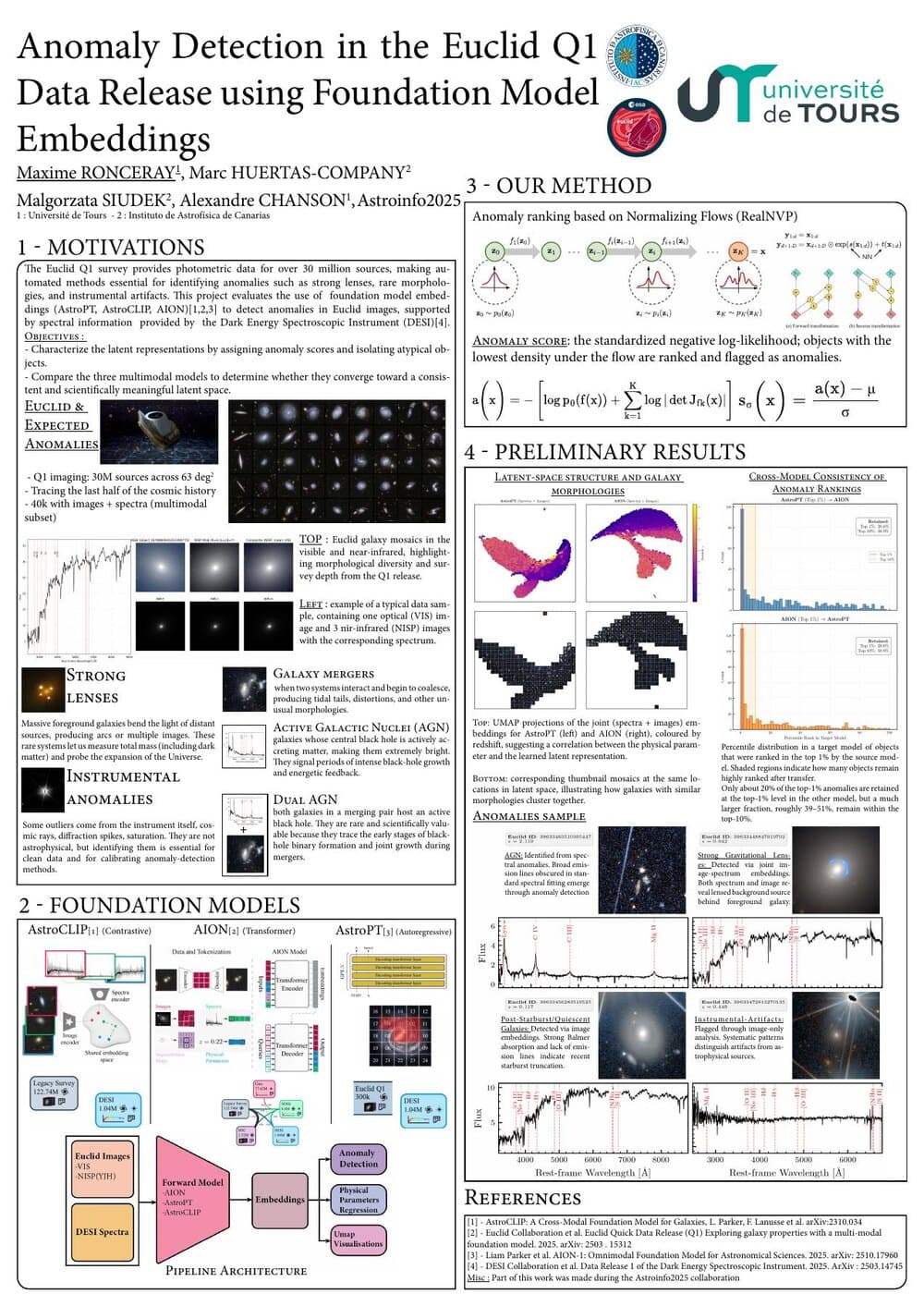
    • Poster about anomaly detection in Euclid Q1 with foundation-model embeddings02

      Poster · 2025

      Anomaly Detection in the Euclid Q1 Data Release using Foundation Model Embeddings

      Data Science Day · University of Tours

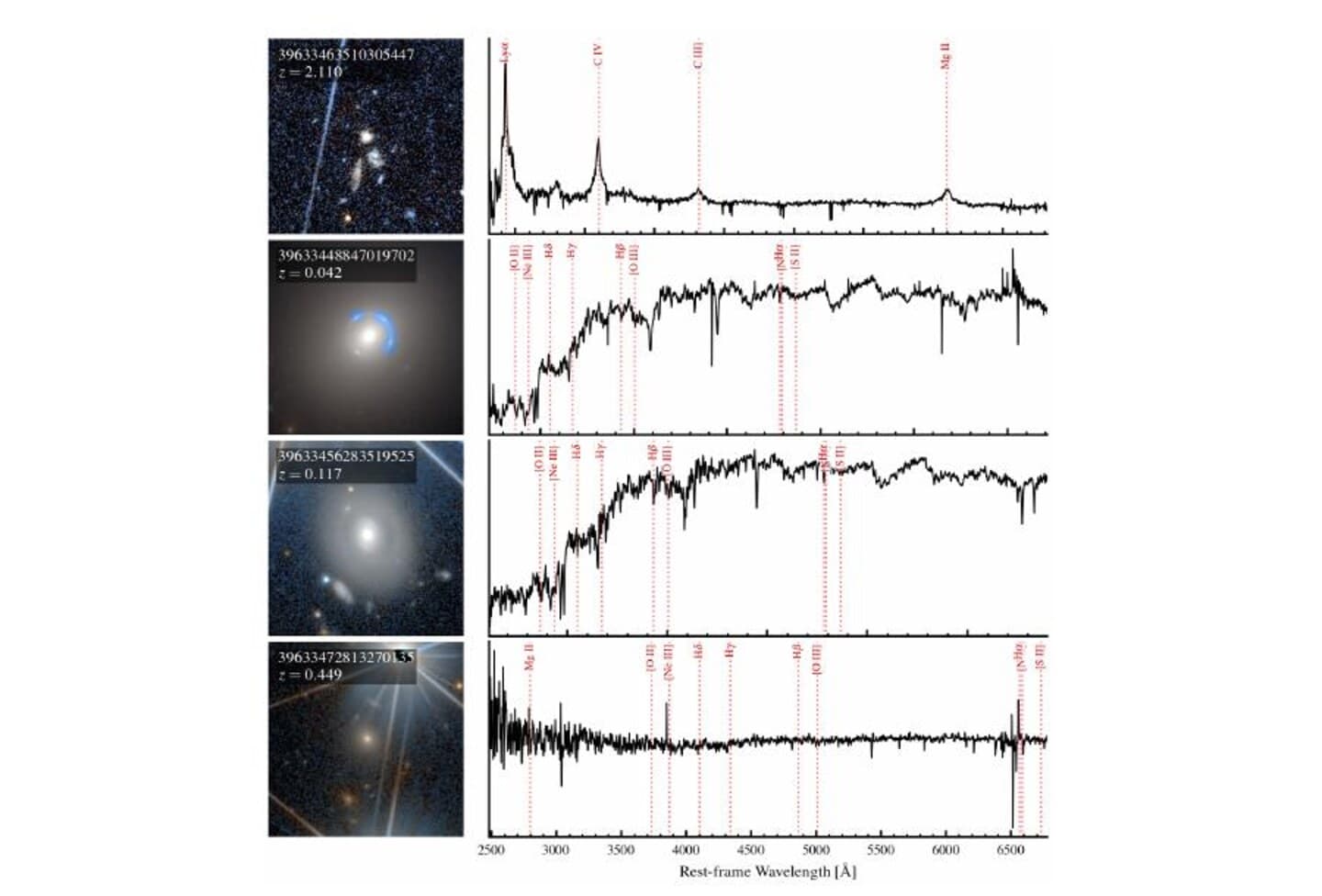
      An anomaly-ranking study across AstroPT, AION and AstroCLIP embeddings, combining Euclid images with DESI spectra to surface rare systems and instrumental artefacts.

      Open full poster

    Talks

    Slides

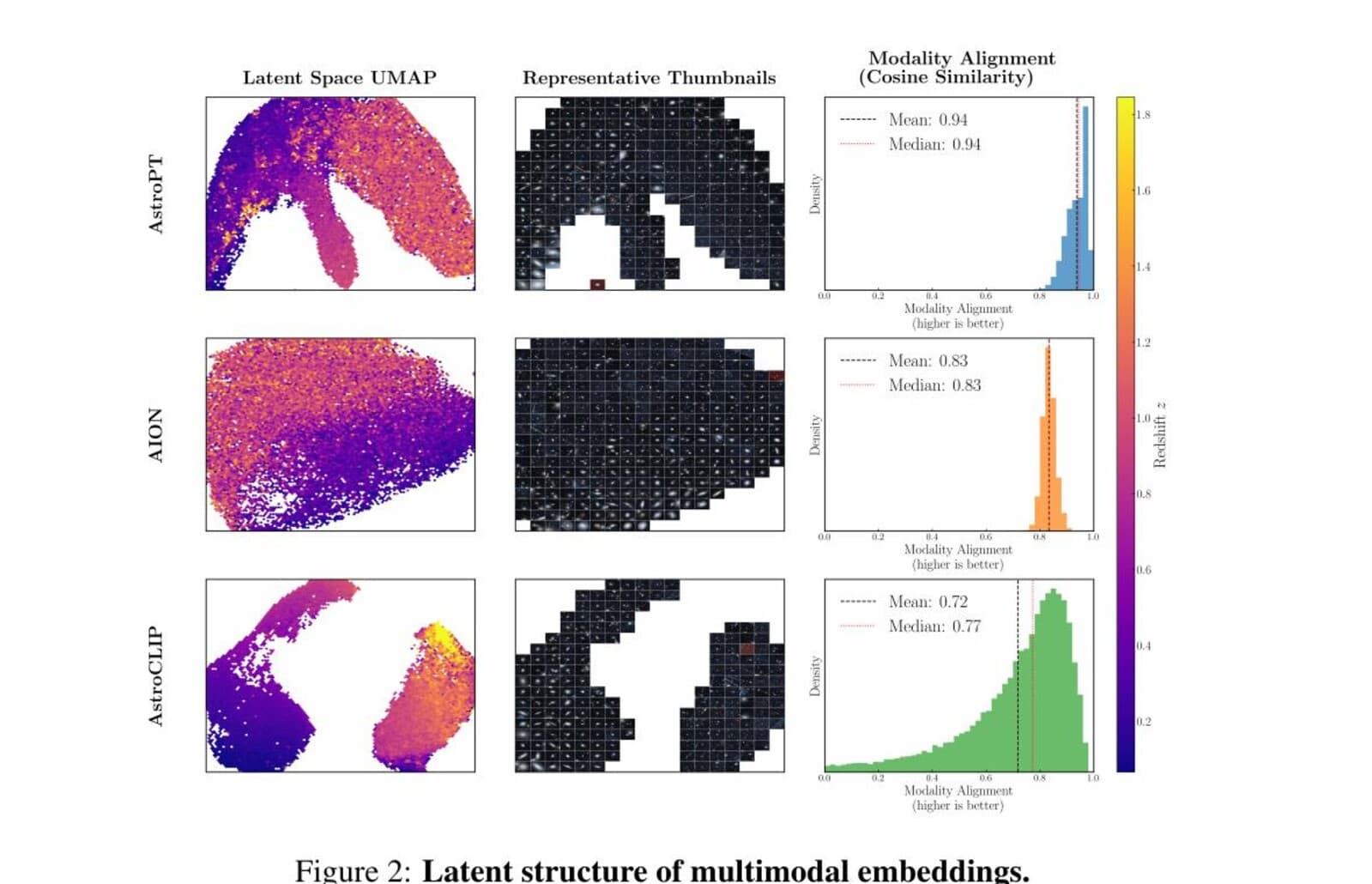
    • Latent-space map and nearest-neighbour examples from the foundation-model benchmark

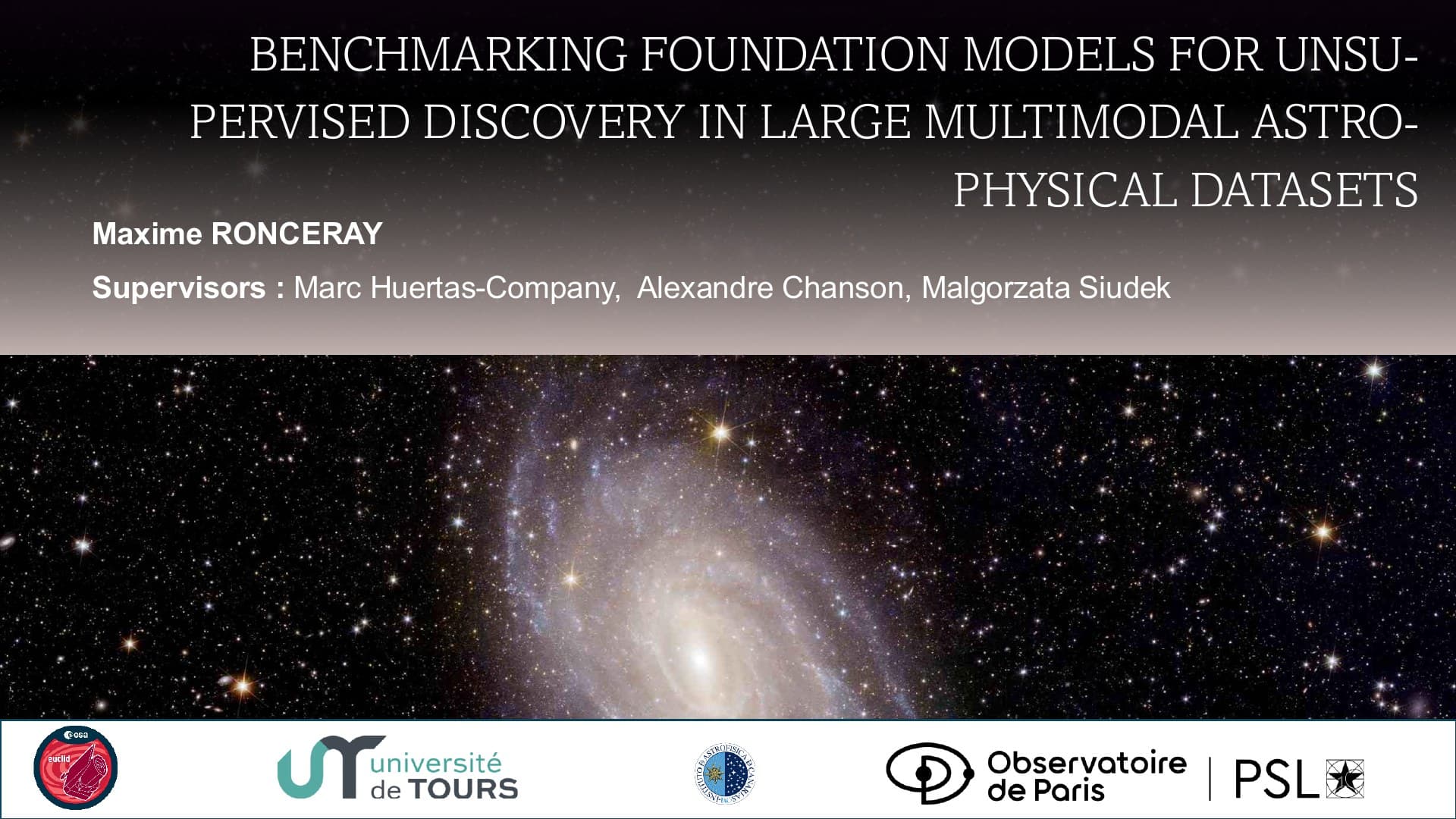
      Benchmarking Foundation Models for Unsupervised Discovery in Large Multimodal Astrophysical Datasets

      Research talk · Blois · 12 Feb 2026

      View slides
    • Opening slide of the Euclid foundation-model anomaly-detection presentation

      Anomaly Detection on Euclid Q1 using Foundation Model Embeddings

      University of Tours · 18 Nov 2025

      View slides
    • Opening slide of the PLASMAG space magnetic-sensor simulation presentation

      Development of a Simulation Environment for Space Magnetic Sensors: PLASMAG

      Café Spatial · LPP / CNRS · 5 Jul 2024

      View slides

    Documents

    Reports

    • PLASMAG logo: Python library for accurate search-coil magnetometer adjustments with a graphical interface

      Technical report · 2024

      Development of a Simulation Environment for Space Magnetic Sensors

      LPP · CNRS / École Polytechnique internship

      Design and implementation of PLASMAG, a modular simulation environment for search-coil magnetometers, including a dependency-driven simulation engine, SPICE integration and sensor-parameter optimization.

      Read full report

    Research focus

    About

    Incoming PhD student at CEA · Astrophysics & machine learning

    I am completing an MSc in Data Science and Artificial Intelligence at the University of Tours. My research focuses on reusable machine-learning representations and probabilistic methods for scientific discovery in large astronomical surveys.

    I have worked on multimodal anomaly detection with Euclid and DESI data, variational inference for galaxy population priors at CEA, and scientific simulation software for space instrumentation at LPP. My foundation-model benchmarking work was accepted at the ICLR 2026 FM4Science workshop.

    Research interests

    • Scientific foundation models
    • Multimodal anomaly detection
    • Simulation-based inference
    • Galaxy populations and SEDs
    • Large astronomical surveys

    Tools & methods

    • Python · JAX · PyTorch
    • Probabilistic inference · Normalizing flows
    • Deep learning · Multimodal transformers
    • HPC · Scientific computing
    • C/C++ · Data engineering